Thursday, November 4, 2010

Union Member Votes Save Democrats from Worse Disaster

By David Moberg 

Nov. 3.2010

In Tuesday’s “extremely disappointing” elections, AFL-CIO president Richard Trumka says, unions “were a firewall” against greater losses for the Democrats, including retention of’ the Senate.   
Indeed, union members once again supported labor-endorsed candidates–overwhelmingly Democrats–by 26 to 28 percentage points on average more than non-union voters (64-36 for House and 62-38 for Senate Democrats). In a few critical races, the union edge was even greater: In Nevada’s close Senate race, union members favored Democratic Senate majority leader Harry Reid by 69 to 29 percent over Tea Party candidate Sharron Angle–arguably providing him his victory, since non-union voters went slightly for Angle.
But the union margin was not as great as in the past two elections, says Guy Molyneux of Hart Research, which polled union members as well as the general electorate in 100 swing Congressional districts. Union members, he says, were susceptible to the same wave of discontent as the general public. (The media exit polls, which identify voters only as from a union household, not as members, showed stronger Republican support in some races than did the Hart poll.)
Union members also vary greatly in their political responses by demographic group. White women overall voted for Republican House candidates by 17 percent, but white union women favored Democrats by 36 percent. White non-college graduates–used by many pollsters as a proxy for white working class voters–favored Republicans by 27 percent, and even union members who had not graduated from college only split their vote 50-50 between the two parties. Even worse, white non-college educated men picked Republicans 67 to 33 percent.
Unions, which spent well over $200 million on this election cycle but were swamped by corporate cash, claim their political mobilization is effective as a result of multiple, issue-oriented educational contacts with members, who trust their unions.
But after many years of observation, I’m still struck by how superficial most of the contacts still are, even though they have improved. Unions will have to give much higher priority to political education if they hope to compensate for loss, or at best slow growth, of membership and to overcome the miseducation of so many non-college white men.
The Hart survey found high dissatisfaction with the economy, and 70 percent of the swing district voters who were very dissatisfied (56 percent of voters) voted Republican. Yet only 35 percent of voters think Republicans have a clear economic plan–close to the 30 percent who think Democrats do.
Most voters knew little about Republican plans, but rejected many of their key ideas by majorities of 62 to 85 percent (for example, 63 percent against tax cuts for earners of $250,000, 62 percent against social security privatization, 75 percent against reducing or eliminating the minimum wage).
Yet by equally lopsided majorities the same voters–a majority of whom cast a ballot for Republicans–supported labor union and Democratic job-creation proposals, such as investing in schools, roads and energy systems, tax credits for new U.S. jobs, and extending unemployment benefits.
“Working people think there wasn’t enough done to help average people, not that there was over-reach,” Trumka said. “They wanted results, and they didn’t see them.” Hart’s survey underscores the point: 43 percent of voters thought Obama helped banks too much, compared to 34 percent who thought Democrats imposed too many regulations.
Despite the unfavorable returns, organized labor will continue to fight for the same agenda as before the election, Trumka said: “Our agenda is jobs, jobs, jobs and more jobs.

Wednesday, November 3, 2010

What's Next?


Today’s a day to be honest.


Yesterday’s election results are deeply disappointing to the millions of voters who supported working family candidates this year. Voters in this election were angry, and for good reason. They’ve felt the pain of economic collapse. And they’ve paid for it with their jobs, their homes and often their hope. Many working people knew in their gut that Washington insiders did too much to help Wall Street and the banks, and not enough to help average people.

But this election was not a mandate for an anti-worker agenda. Voters in swing congressional districts overwhelmingly reject privatizing Social Security and raising the Social Security retirement age, they oppose tax cuts for the top 2 percent who make more than $250,000 a year, they reject abolishing the Department of Education and they oppose reducing or eliminating the minimum wage.

Now that Republicans will be in control of the House of Representatives, their leaders have to step up to the plate. If they keep saying “no,” we’ll make sure voters know exactly who failed them on jobs and fixing the economy in 2012.

Click here to watch my brief video outlining our next steps.

President Obama inherited two wars and an economy teetering on the brink of a second Great Depression. He took immediate steps to avert catastrophe. Years from now, we’ll look back and see these two years as the most eventful for working families in 40 years.

But the economy is still a mess, and we have difficult work ahead. It’s up to us to force these new members of Congress to move bold initiatives to fix our economy and put America back to work—or force them to pay the price for inaction in 2012.

Watch my video, and get involved.

America’s labor movement fought tirelessly for working families until the last polls closed on the West Coast Tuesday. 
I’m proud that I can count on you to jump into the fight for working families all over again, starting right now. With your help, we’ll work harder than ever to build an economy that works for everyone.

In solidarity,


Richard Trumka
President, AFL-CIO
P.S. We expect critical legislative battles to take place in the coming weeks and months, with as little as 24 hours’ notice. We’ll need to alert you right away. Once you’ve watched my video, be sure to sign up for occasional, timely text messages. Just text NOW to 225568. (Message and data rates may apply.)

Friday, October 29, 2010

Unionbusting Firm Likens Organizers to Terrorists

This article sheds some light on how the Jimmy John's workers lost their representation election.  If the general public understood that workers face intimidation, coercion and even firing during a union representation election, EFCA couldn't have been spun to sound like a nefarious plot to subvert democracy.  Did you get those crazy giant post cards from the Missouri Republican State Committee?  Like the "Robbin" Carnahan piece that said, "Robin Carnahan supports big labor's Card Check plan that would take away a worker's right to a secret ballot when deciding whether to join a labor union.  IT IS ESTIMATED THAT THE CARD CHECK SCHEME CARNAHAN SUPPORTS WOULD KILL 600,000 JOBS ACROSS AMERICA."    The voters who took the time to read the post card don't know the reality of union elections.  They probably imagine that a union election is similar to elections for state office(no intimidation or fear of losing their job).  They will never know unless the labor movement gets serious about organizing.


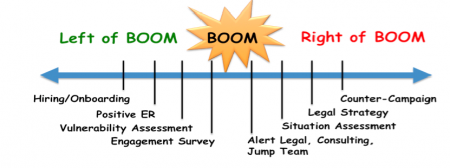
LRI's tactical continuum, modeled after the U.S. military's approach to defeating insurgents in Iraq. The "boom" is a union organizing drive.   (Image courtesy Labor Relations Institute, Inc., 2010)


Working In These Times
by Lindsay Beyerstein

The Labor Relations Institute helps keep workplaces 'left of boom"
Unionbusting is a multimillion dollar industry that has grown significantly since the 1970s. At least two-thirds of employers hire anti-union consultants to counter organizing drives.
According to economist John Logan, the unionbusting industry has evolved over the past few decades to focus on preventing organizing before it starts. Unionbusting is as old as unions. However, according to Logan, a new generation of consultants are "actively and aggressively creating that demand by encouraging management to fear the allegedly catastrophic consequences of unionization."
The Oklahoma-based Labor Relations Institute has taken fear-based marketing to new heights. LRI was reportedly hired to defeat an Industrial Workers of the World organizing drive at ten Jimmy John's sandwich shops in Minneapolis. One LRI white paper entiled "Left of Boom" likens union organizers to IED-planting Iraqi insurgents
The 2010 paper, available for free on LRI's website, argues that preventing unionization is a lot like defeating an insurgency. The report drives the point home with a photo of a military vehicle engulfed in flames. In Iraq, so-called "Left of Boom" (LOB) tactics are aimed at preventing insurgents from setting IEDs by identifying and disrupting the networks of influence that link bomb-makers to bomb setters.
"The military monitors, arrests, interrogates, and then turns over any members of the network to the Iraqi or Afghani governments for criminal prosecution," the paper explains. So-called Right of Boom" (ROB) tactics are steps taken to respond to an IED attack after it occurs.
The high-pressure marketing message is that your company should hire LRItoday to stamp out the slightest murmur of labor unrest. If you wait for the "boom"—the union organizing drive—it may already be too late, according to the paper. LRI claims that the very survival of your company may hinge upon keeping the union out. The paper asserts that organizing campaigns are often harmful to the physical and emotional health of workers and may even spark violence.
So, what's a terrified boss to do? Luckily, LRI is here to help. The first step is systematic surveillance and data gathering. The Institute's LOB tactics include surveys and structured interviews to identify dissatisfied employees and map out networks of influence within the workplace. ROB tactics include various "pushback" strategies to counter an organizing campaign in progress. 
According to yet another white paper, employees can be scientifically "segmented" into one of five "buckets," which correspond to one of five smily faces, depending on how positively they feel about the company. LRI claims that segmenting the workforce is a key step in preventing labor unrest.
As part of its suite of LOB services, LRI offers two kinds of unionbusting training for managers and supervisors: active interval training, and trip wire training.
"The active interval training is designed to teach supervisors how not to be a jerk," according to the paper. It's a self-paced online course.
Trip Wire training purportedly teaches supervisors to recognize "the often subtle behavioral signs of union organizing" so that they can trigger a "silent alarm button," according to another white paper on the LRI website entitled "Is There a Target on My Back?":
Here’s an example. Suppose a union meeting occurs one night, run according to typical organizer playbook. They are asked to do various things by the organizer – they are often told to keep things quiet and are encouraged to assume the worst about their management team. The employees who attended will behave differently the next day. If supervisors are properly trained to pay attention when “something doesn’t feel right” about how employees are behaving, we have created the tripwire.
The white paper doesn't specify what those subtle signs are. It's probably very expensive to find out.
If you want to get really far out on the left edge of the spectrum, you can hire a "fake union organizer" aka "Mystery Shopper" from LRI to attempt to infiltrate your company and identify vulnerabilities. The fake union organizer will contact your employees by phone and in the workplace and report back to you.
"The Shopper may also talk to people in the community – at bars or stores near the facility – to see what people say about the company, just like a union organizer would (the consultant is careful never to ask an employee what they think about unions)," according to the white paper. The faux organizer will gague how easy it is for an outsider to infiltrate the employee parking lot and the break room. The fake union organizer will even "determine how easy it is to get into the dumpsters, and what they might find in the trash that they could use in an organizing campaign."

Wednesday, October 27, 2010

Jimmy John’s Workers Narrowly Reject Union—and Underscore Potential Power of EFCA

This was an amazingly close vote given everything the workers faced from management.

By Lindsay Beyerstein

Octboer, 25, 2010
Working In These Times


Workers at 10 Jimmy John'ssandwich shops in Minneapolis on Friday narrowly rejected a bid to form a union by a vote of 87-85. If the Employee Free Choice Act (aka card check) were the law of the land, these ten outlets would already have a union. About 60 percent of the franchise's 200 workers signed pro-union cards asking the NLRB to hold the vote.

It seemed as if these Jimmy John's outlets were about to become the first unionized franchise in a national fast food chain. Jimmy John's has about 1,000 sandwich shops in 39 states.
A vote to unionize would have been a coup for the Industrial Workers of the World (IWW), the union behind the Jimmy John's organizing drive. So far, the fast food industry has proved nearly impossible to unionize. Less than 1% of the U.S. fast food industry is unionized.
So, how did a comfortable margin of support with card check turn into a narrow loss at the polls? The same way it usually does with NLRB elections: The vote is scheduled and the workers become management's captive audience for anti-union propaganda.
Jimmy John's launched an aggresive anti-unionization campaign ahead of the election. The discrepancy between about 120 signed pro-union cards and 85 votes shows how powerful this kind of onslaught can be. The restaurants are owned by Mike Mulligan, a retired vice president of communications for SuperValu.
The pro-union faction is alleging widespread management misconduct in the run-up to the vote. It is illegal under the National Labor Relations Act for management to attempt to influence a vote by firing, threats of firing, bribes, or other inducements.
There are four charges pending against Miklin Enterprises, according to a board spokeswoman. Three of the four charges cite multiple alleged violations. Amongst other things, Miklin managers are accused of offering to pay an employee to vote in the NLRB election, firing two employees for pro-union activities, kicking a pro-union employee out of a "captive audience" meeting, and threatening to retaliate against employees for unionizing, according to charge documents provided by the NLRB to Working In These Times.
In September, Miklin managers also allegedly sent two pro-union workers home to shave, enforcing a policy that they never upheld before. The facial hair crackdown seems suspicious in light of Jimmy John's famously flexible dress code. Just last week, the New York Times reported that "[m]any of their young workers wear nose rings, beards and dreadlocks."
The NLRB will investigate the charges. If the investigators determine that the allegations have merit, the NLRB will file complaints against the company, which will be adjudicated by an administrative law judge.
The pro-union faction at Jimmy John's has vowed to fight on. "In a company with turnover approaching 50% each month, a majority at any given moment only means so much," said delivery driver Ayo Collins.
As Kari Lydersen reported for Working In These Times, the grievances of Jimmy John's workers are typical of the fast food industry: low pay, lack of sick days, no benefits, irregular and unpredictable hours, truncated shifts, and widespread sexual harrassment. In September, Jimmy John's employees rallied in support of supervisor Margaret Brickely, who was threatened with dismissal after she refused to serve spoiled meat. (This allegation is also cited in one of the charges filed with the NLRB.)
Jimmy John's website says of its employees: "Their hustle is part of how they live their daily lives, and they enjoy the fruits of a hard-earned entrepreneurial lifestyle."
The sandwich-makers and delivery drivers certainly hustle--often through the Minnesota snow, without hazard pay. But when it comes to enjoying the "fruits of an entrepreurial lifestyle," Jimmy John's is still the pits.

Thursday, October 14, 2010

Pensions: The Next Casualty of Wall Street

More on the coming pension wars. Labor has to put up a huge fight to save our pensions.  Let's stay on top of this one.

by Mark Brenner, Labor Notes, Sept. 2009
Nobody wants to admit it, but the next casualty of the Wall Street meltdown will probably be your golden years. For years corporations have been trying to choke the life out of traditional pensions, working hard to get out from under the risk—and the cost—of providing for their retirees. Between last year’s credit crunch and changes to federal pension laws, they may get their wish.

Nearly $4 trillion worth of retirement savings were wiped out in the first weeks of the 2008 financial freefall. Half of the drop was concentrated in traditional pension plans, also known as defined-benefit plans. While most workers in these plans haven’t had their monthly benefits cut, unlike the 46 million people riding the stock market with 401(k) defined-contribution plans, the storm clouds are gathering.
Labor needs a strategy to protect what we’ve won. But holding our ground requires moving from defense to offense. If the pension crisis is going to be solved for union members, it has to be solved for everyone.

UNCOMFORTABLE ARITHMETIC

Even before the financial crisis, traditional pensions were a vanishing breed. Thirty years ago more than a third of the private sector workforce had traditional pensions. Last year that number was down to 16 percent.
Driving the decline were employers looking to get off cheap, eliminating pensions entirely when they could get away with it, and when they couldn’t, shifting to 401(k)s. These programs were legalized in 1978 and were originally designed to supplement traditional pensions. Now they’re choking them out like kudzu.
Corporations got a great deal, paying about half what they used to towards their workers’ retirement by the ’90s. Even more important—as anyone who has opened their 401(k) statement recently can attest—the move shifted risk off companies and onto us.
Traditional pensions were a collective solution to a collective problem. Young and old contributing together smoothed out insecurity for all. Now it’s just you and the stock market—with far less in your pocket.
Even before the crash, studies showed that 401(k)s leave workers with 10 to 33 percent of what traditional pensions provide. Given the 30-year squeeze on wages, most people haven’t saved much either, which explains why more than half of all 401(k) participants have less than $75,000 when they retire.

WHAT’S IN STORE?

Even for those with superior defined-benefit plans, the last 20 years have been rocky. Companies spent much of the 1990s gaming the system, siphoning off pension funds to pad the bottom line.
At the start of this year the nation’s defined-benefit pension plans had only about 75 percent of what they owed participants. Companies may need to contribute as much as $100 billion to cover these gaps.
Although Congress waived compliance with new pension rules this year, the law will eventually take effect, and will force employers to cover these pension gaps. Rather than clean up their act, more and more employers are looking for the exit. By April of this year nearly a third of America’s largest companies had frozen their pension plans.
Many others are invoking the nuclear option, declaring bankruptcy as a way to unload their pension plans on the taxpayers. Unfortunately, the Pension Benefit Guaranty Corporation (PBGC), established in 1975 to backstop private sector pensions, is already reeling from a decade of high-profile and expensive pension defaults at companies like United Airlines and steelmaker LTV.
Nine of the 10 largest pension defaults in history occurred since 2000, leaving the PBGC with a deficit of $11 billion at the end of 2008. That gap could swell to more than $100 billion over the next few years, amounting to a backdoor bailout for big corporations, and a bitter pill for abandoned retirees.
Workers at Republic Steel saw first hand how it works when they had their pensions cut by $1,000 a month in 2002 by the PBGC and then cut again in 2004. Five workers from the Lorain, Ohio, plant committed suicide after the first time their pension was diminished. In the second round of cuts, retirees like Bruce Bostick, former grievance chair for USW Local 1104, saw their retirements fall from $1,047 a month to $125.
The situation for public sector workers isn’t much better. Although 80 percent of public employees have traditional pensions, those benefits are now in the cross-hairs of conservative and liberal politicians. Two-thirds of public sector pension plans are underfunded—to the tune of $430 billion—and state and local budget crises are pitting taxpayers against public employees from California to Maine.

ANCHORING RETIREMENT

For nearly 20 years the various financial bubbles—from the dot-com frenzy of the 1990s to the recent housing market run-up—papered over the urgent need to address the faltering retirement system.
Wall Street’s collapse last year revealed how the current patchwork of retirement plans is failing almost everyone. As with health benefits, union workers with stable pensions increasingly find themselves on an island of security in a sea of uncertainty.
But the water is rising rapidly.
As the debate over the auto bailout and state budget crises revealed, defending your own decent pension is tough work when half the workers in the country don’t have any retirement at all.
The PBGC—which has been swimming in red ink since 2002—is currently set up to pay less than half of what people were promised. If the funding gaps widen, it could fall to pennies on the dollar.
There will be calls to bail the PBGC out—which needs to happen—1.2 million people now depend on it. A sensible demand is to make it function more like the FDIC, by guaranteeing 100 percent of pension benefits up to a reasonable threshold.
But reform can’t stop there.
If it does, workers are on the same path as before the economic collapse, with a temporary reprieve. Employers will still seek to drive union workers down to non-union standards and dump more risk onto individuals.
We need to return to the original vision of Social Security: a program that (like in Western European nations) can actually pay for most of your old-age living expenses.