Now that is pretty Icky!
Abandoning ALEC
Wednesday, June 13, 2012
Jim Hightower
Good Grief ALEC is even too icky for Wal-Mart!
The American Legislative Exchange Council is the corporate-financed bill mill that thinks up reams of anti-labor, anti-consumer, anti-environment, anti-democracy, and other anti-people laws favored by its corporate funders. It then works with Republican law makers in state legislatures to introduce about 1,000 of these cookie-cutter bills every year in statehouses all over the country. Until recently, ALEC largely operated clandestinely but such watchdog groups as Center for Media and Democracy, Color of Change, and Nation magazine have now outed it as the insidious force behind some of America's most-extreme, right-wing legislation.
By not only exposing the raw ugliness of the front group's agenda, but also naming its corporate backers, the fiesty watchdogs are producing a rush of brand-name, Fortune 500 firms fleeing ALEC. Let's call the roll of some that have discontinued their membership and sponsorship so far this year: Coca Cola, Pepsi, Kraft Foods, Intuit, McDonald's, Wendy's, Mars Candies, Blue Cross Blue Shield, YUM! Brands (including Pizza Hut), Procter & Gamble, Amazon, and Medtronic.
And, on May 30, even the far-right-wing, anti-worker,
ethically-challenged Wal-Mart empire abandoned the ALEC ship. "We feel that the divide between [ALEC's political] activities and our purpose as a business has become too wide," declared Wal-Mart's head of lobbying and PR. "To that end, we are suspending our membership."
Like the infamous Koch brothers (who continue to stay aboard the Legislative Exchange Council's sinking ship), the very name of ALEC has become a political epithet, a symbol of the corruption of America's democratic values by the plutocratic elite. To keep up with developments, go to www.ALECexposed.org.
"Wal-Mart latest to leave conservative ALEC advocacy group,"
www.reuters.com, May 31, 2012.
Thursday, June 14, 2012


Tuesday, June 12, 2012
ST. LOUIS NURSES SAY YES TO UNION
Congratulations to the nurses at St. Louis University Hospital!
RNs AT SAINT LOUIS UNIVERSITY HOSPITAL VOTE BY 76% TO AFFILIATE WITH NATIONAL NURSES UNITED
6/8/12
ST. LOUIS – By a landslide of 76 percent, registered nurses at Saint Louis University Hospital (SLUH) Thursday night voted to join the National Nurses Organizing Committee-Missouri (NNOC-Missouri), an affiliate of the 175,000-member National Nurses United (NNU), the largest union and professional association of RNs in the U.S.
The secret ballot election was conducted by the National Labor Relations Board. The final count was 305 to 99 to affiliate with NNOC-Missouri/NNU, which will now represent the more than 600 registered nurses at SLUH.
“We are so happy that we SLUH RNs will now have a vehicle to negotiate for improved patient care, salaries, and benefits that can recruit and retain the best nurses for the best patients in St. Louis. We have no illusions about the work ahead but with unity and resolve, we look forward to a bright future,” said Lesa Dustman, an intensive care unit RN at SLUH.
Saint Louis University Hospital is part of the Tenet Healthcare system. NNU affiliates currently represent approximately 4,000 RNs in nine Tenet hospitals in Florida, Texas, and California.
NNU leaders said the SLUH election will inspire other nurses in the region.
“This is a game changer for nurses and patients throughout St. Louis and the region,” said NNU Executive Director RoseAnn DeMoro, a St. Louis native. “Wherever nurses have won a collective voice through NNU, they have been able to make a substantial difference in the delivery of safe patient care and to elevate standards for themselves and their families.”
“For the community of St. Louis and all nurses, this is just the beginning. We are on the move and we are here to stay,” DeMoro said.
“We are excited to welcome fellow RNs from Saint Louis University Hospital,” said Sherri Stoddard, RN, chair of NNOC’s national Tenet RN Bargaining Council. “We strive every day to maintain patient care standards across the board in Tenet hospitals. Informed and unified, we work together with our elected Professional Practice Committee to make this happen. When RNs come together like this, patients, nurses, and communities win.”
From coast to coast, RNs have been joining NNU and its affiliates due to a solid record of successful advocacy for strong patient safety standards, economic and workplace improvements for RNs, and NNU’s reputation for promoting legislation to benefit patients, nurses, and communities.
Since its founding two and a half years ago, NNU has organized more than 30 hospitals and 13,000 RNs in 10 states.
“National Nurses United and our affiliates around the country are successful because we speak to the needs of patients,” said Jean Ross, RN and NNU co-president. “What’s more, we see what’s happening in our communities and we won’t stand by. Our care extends beyond the bedside. And that’s bringing more RNs into the fold.”
RNs AT SAINT LOUIS UNIVERSITY HOSPITAL VOTE BY 76% TO AFFILIATE WITH NATIONAL NURSES UNITED
6/8/12
ST. LOUIS – By a landslide of 76 percent, registered nurses at Saint Louis University Hospital (SLUH) Thursday night voted to join the National Nurses Organizing Committee-Missouri (NNOC-Missouri), an affiliate of the 175,000-member National Nurses United (NNU), the largest union and professional association of RNs in the U.S.
The secret ballot election was conducted by the National Labor Relations Board. The final count was 305 to 99 to affiliate with NNOC-Missouri/NNU, which will now represent the more than 600 registered nurses at SLUH.
“We are so happy that we SLUH RNs will now have a vehicle to negotiate for improved patient care, salaries, and benefits that can recruit and retain the best nurses for the best patients in St. Louis. We have no illusions about the work ahead but with unity and resolve, we look forward to a bright future,” said Lesa Dustman, an intensive care unit RN at SLUH.
Saint Louis University Hospital is part of the Tenet Healthcare system. NNU affiliates currently represent approximately 4,000 RNs in nine Tenet hospitals in Florida, Texas, and California.
NNU leaders said the SLUH election will inspire other nurses in the region.
“This is a game changer for nurses and patients throughout St. Louis and the region,” said NNU Executive Director RoseAnn DeMoro, a St. Louis native. “Wherever nurses have won a collective voice through NNU, they have been able to make a substantial difference in the delivery of safe patient care and to elevate standards for themselves and their families.”
“For the community of St. Louis and all nurses, this is just the beginning. We are on the move and we are here to stay,” DeMoro said.
“We are excited to welcome fellow RNs from Saint Louis University Hospital,” said Sherri Stoddard, RN, chair of NNOC’s national Tenet RN Bargaining Council. “We strive every day to maintain patient care standards across the board in Tenet hospitals. Informed and unified, we work together with our elected Professional Practice Committee to make this happen. When RNs come together like this, patients, nurses, and communities win.”
From coast to coast, RNs have been joining NNU and its affiliates due to a solid record of successful advocacy for strong patient safety standards, economic and workplace improvements for RNs, and NNU’s reputation for promoting legislation to benefit patients, nurses, and communities.
Since its founding two and a half years ago, NNU has organized more than 30 hospitals and 13,000 RNs in 10 states.
“National Nurses United and our affiliates around the country are successful because we speak to the needs of patients,” said Jean Ross, RN and NNU co-president. “What’s more, we see what’s happening in our communities and we won’t stand by. Our care extends beyond the bedside. And that’s bringing more RNs into the fold.”
Thursday, June 7, 2012
What Labor’s Loss in Wisconsin Does—and Doesn’t—Mean
Analysis of the Wisconsin Election Results.
Working In These Times
Thursday Jun 7, 2012
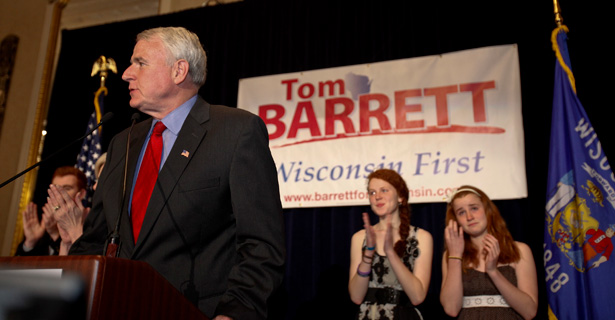
Milwaukee
Mayor Tom Barrett makes his concession speech to supporters June 5,
2012 in Milwaukee, Wis. (Photo by Andy Manis/Getty Images)
There's no point mincing words: By rejecting the recall of Republican
Gov. Scott Walker, Wisconsin voters dealt a nasty blow to organized
labor and progressives in the state and beyond.
That was especially true since Wisconsin unions and liberals picked this particular fight, even if it was a justifiable but politically risky response to the governor taking away the rights of public workers.
Quickly, right-wing leaders and commentators—and even some liberals—declared the vote the death knell of unions, especially in the public sector, and a public legitimation of hard-line anti-union strategies. And it could turn into a PATCO moment—when Ronald Reagan fired striking air traffic controllers—if organized labor and its allies fail to launch an effective counter-attack on behalf of not only labor rights but more broadly economic justice and democracy.
But single victories rarely translate into triumphal waves. The right reads too much into their win. Few Republican governors would like to undergo the protests Walker has faced, even if they keep their office.
Yet a strong trend has emerged among both Democrats and Republicans toward attacking public employees, following the successful decades-long offensive against private sector unions. And the Supreme Court's Citizens United decision will keep the floodgates open to the gush of money from right-wing billionaires that gave Walker an overwhelming financial edge (perhaps eight to one).
The recall vote "was not the end of something but the beginning," AFL-CIO President Richard Trumka said, referring to a "new model" of labor and community mobilization, a new determination "to hold politicians accountable," and an emerging movement for economic justice.
Labor and its progressive allies are hardly dead after Tuesday, but they need to take the defeat seriously. They could start by acknowledging that many unions have failed to educate and energize their own members adequately and that much of the public, including even theoretically friendly politicians, do not appreciate—or feel any benefit from—a shrinking, sometimes insular movement.
In these hostile times, unions need to pre-emptively create broad coalitions—such as Wisconsin formed in reaction to Walker—and more means of outreach to educate the public, especially the working class, about how our society fails to work for the 99 percent and why unions still play a crucial role at work and in politics.
Some implications of the recall vote are murky because the factors in the election are complex. For example, Walker kept his office by a larger margin than when he first won a year and a half ago, but Republicans lost control of the state Senate when one Democrat won in a recall contest. (That opens up a way to stop much of Walker's agenda, but the Senate will probably not meet until next year.) That slightly tempers the loss.
Also, although labor unions and many supporters saw the recall as a referendum on labor rights, Democrats and Barrett himself downplayed public workers' rights in the recall battles, with both parties emphasizing other issues. That makes the meaning of the vote less clear—in contrast with voters' strong rejection of S.B. 5's anti-labor provisions in Ohio.
Also, 60 percent of voters in exit polls said they thought a recall was appropriate only in cases of misconduct. That reluctance to recall showed up in last year's Senate campaigns and constitutes one of the main reasons Walker won.
Wisconsin voters were deeply divided on public workers' union rights and somewhat at odds with themselves. In exit polls, by 51 to 45 percent, voters expressed a favorable view of public employee unions, but by almost inverse divisions—52 to 47 percent—they approved both limiting collective bargaining and how Walker handled collective bargaining. Nationally, however, a New York Times poll in February 2011 found Americans opposed taking away collective bargaining rights by 60 to 33 percent.
Even though the anti-Walker movement lost this fight, it is still alive as a movement, including new or revitalized organizations like We Are Wisconsin and Milwaukee-based Wisconsin Jobs Now.
"The story of Wisconsin is the story of fighting back and the force of mass offensives," says SEIU Healthcare Wisconsin Vice President Bruce Colburn. "Wisconsin set a good example of that willingness to take on that fight," possibly giving other, less ideological governors than Walker pause about following his path.
But membership in public employee unions has dropped. The Wall Street Journal reports AFSCME in Wisconsin has declined from 62,818 in March 2011 to 28,745 in February 2012, though AFSCME disputes those numbers. Meanwhile, SEIU has lost some government members and is likely to lose many more in 2014 when its contract with the University of Wisconsin expires, and with it, their right to bargain a new contract. So far, few unions have re-organized their workplaces to prepare workers to act collectively even without bargaining.
The right also used Wisconsin as a test for developing its political "ground game," which some reports described as rivaling labor's own infrastructure. While some pundits see dangers that Obama could now lose Wisconsin, which he won by a large margin over John McCain in 2008, the exit polls showed Obama favored over Romney by 51 to 44 percent. The presidential race will likely be tight, but Walker's victory does not pose a great setback for Obama, except for motivating the far right and for stimulating development of field operations.
Unlike the Republicans, the national Democrats and Obama stayed relatively distant—with the president's main, pathetic role consisting of sending out a tweet at the last minute in support of Barrett. This strategy of avoiding an intensely felt but probably losing candidacy may be smart, if not particularly principled, politics on the part of Team Obama, but to the extent that it sets back labor unions, it hurts Democratic electoral prospects.
More important to the state of the union, if not the president's campaign, declining unions are implicated in rising inequality, worse health, and weakened democracy.
Do even union members realize that? Searching the beer and brat leftovers of Tuesday night for clues, the answer is yes—and no.
Union members and their households turned out only somewhat more forcefully to vote than non-union voters. According to exit polls, 17 percent of voters were union members, though in 2011 they constituted about 13 percent of the state's workforce, and they voted 71 percent for Barrett, 28 percent for Walker.
According to a Hart Research poll of union members for the AFL-CIO, 85 percent of public-sector union members voted for Barrett, 15 percent for Walker. Private-sector union members voted 69 to 31 for Barrett (for a combined union member tally of 75 to 25 percent split). Voters from households with a union member—32 percent of the electorate, according to the exit polls—cast 62 percent of their ballots for Barrett, compared to 39 percent for the Democrat from households with no union member.
Considering Walker's extreme actions against public union members and the protests against him, the private-sector unionist vote does not show unusually strong support for the recall. But Hart found that 79 percent of private-sector union members believe in public workers' right to bargain collectively—not too bad but not overwhelming solidarity.
Measured against usual performance, public workers were, not surprisingly, strongly for the recall. While some association with a union seemed to have significantly influenced voters to oppose Walker, a large bloc of union members was not moved by Walker's attack on unions—including people who object to unions, hold a right-wing worldview, vote on specific social issues or otherwise part company with their union. The weak support for the anti-Walker campaign from other, non-union workers is more of a problem, since they form a bigger share of the voters.
Overall, Barrett won a few distinct groups of voters—the poor, the very educated, the young, minorities, single women (and union members). He lost the wealthy. He also lost the non-college educated (56 to 43 percent), and he split whites making $50,000 or less evenly. But despite attempts to work with these voters, such as the AFL-CIO's Working America organization, many of these non-union but working-class voters simply don't identify with the labor movement.
Looking ahead, both sides are geared up for the November elections, and voters are energized, says Rob Zerban, challenger to Republican budget chair Paul Ryan in the southeast corner of the state.
Though encouraged by the state Senate recall victory within the Congressional district where he is running, Zerban says, "The races are different. But anytime there is more participation by Democrats, it's a good sign." He does not believe Walker's victory will hurt his campaign.
The recall fallout can—and must—be contained. But it will take more serious member education, mobilization and the creation of meaningful coalitions that reach out more broadly than has happened before.
That was especially true since Wisconsin unions and liberals picked this particular fight, even if it was a justifiable but politically risky response to the governor taking away the rights of public workers.
Quickly, right-wing leaders and commentators—and even some liberals—declared the vote the death knell of unions, especially in the public sector, and a public legitimation of hard-line anti-union strategies. And it could turn into a PATCO moment—when Ronald Reagan fired striking air traffic controllers—if organized labor and its allies fail to launch an effective counter-attack on behalf of not only labor rights but more broadly economic justice and democracy.
But single victories rarely translate into triumphal waves. The right reads too much into their win. Few Republican governors would like to undergo the protests Walker has faced, even if they keep their office.
Yet a strong trend has emerged among both Democrats and Republicans toward attacking public employees, following the successful decades-long offensive against private sector unions. And the Supreme Court's Citizens United decision will keep the floodgates open to the gush of money from right-wing billionaires that gave Walker an overwhelming financial edge (perhaps eight to one).
The recall vote "was not the end of something but the beginning," AFL-CIO President Richard Trumka said, referring to a "new model" of labor and community mobilization, a new determination "to hold politicians accountable," and an emerging movement for economic justice.
Labor and its progressive allies are hardly dead after Tuesday, but they need to take the defeat seriously. They could start by acknowledging that many unions have failed to educate and energize their own members adequately and that much of the public, including even theoretically friendly politicians, do not appreciate—or feel any benefit from—a shrinking, sometimes insular movement.
In these hostile times, unions need to pre-emptively create broad coalitions—such as Wisconsin formed in reaction to Walker—and more means of outreach to educate the public, especially the working class, about how our society fails to work for the 99 percent and why unions still play a crucial role at work and in politics.
Some implications of the recall vote are murky because the factors in the election are complex. For example, Walker kept his office by a larger margin than when he first won a year and a half ago, but Republicans lost control of the state Senate when one Democrat won in a recall contest. (That opens up a way to stop much of Walker's agenda, but the Senate will probably not meet until next year.) That slightly tempers the loss.
Also, although labor unions and many supporters saw the recall as a referendum on labor rights, Democrats and Barrett himself downplayed public workers' rights in the recall battles, with both parties emphasizing other issues. That makes the meaning of the vote less clear—in contrast with voters' strong rejection of S.B. 5's anti-labor provisions in Ohio.
Also, 60 percent of voters in exit polls said they thought a recall was appropriate only in cases of misconduct. That reluctance to recall showed up in last year's Senate campaigns and constitutes one of the main reasons Walker won.
Wisconsin voters were deeply divided on public workers' union rights and somewhat at odds with themselves. In exit polls, by 51 to 45 percent, voters expressed a favorable view of public employee unions, but by almost inverse divisions—52 to 47 percent—they approved both limiting collective bargaining and how Walker handled collective bargaining. Nationally, however, a New York Times poll in February 2011 found Americans opposed taking away collective bargaining rights by 60 to 33 percent.
Even though the anti-Walker movement lost this fight, it is still alive as a movement, including new or revitalized organizations like We Are Wisconsin and Milwaukee-based Wisconsin Jobs Now.
"The story of Wisconsin is the story of fighting back and the force of mass offensives," says SEIU Healthcare Wisconsin Vice President Bruce Colburn. "Wisconsin set a good example of that willingness to take on that fight," possibly giving other, less ideological governors than Walker pause about following his path.
But membership in public employee unions has dropped. The Wall Street Journal reports AFSCME in Wisconsin has declined from 62,818 in March 2011 to 28,745 in February 2012, though AFSCME disputes those numbers. Meanwhile, SEIU has lost some government members and is likely to lose many more in 2014 when its contract with the University of Wisconsin expires, and with it, their right to bargain a new contract. So far, few unions have re-organized their workplaces to prepare workers to act collectively even without bargaining.
The right also used Wisconsin as a test for developing its political "ground game," which some reports described as rivaling labor's own infrastructure. While some pundits see dangers that Obama could now lose Wisconsin, which he won by a large margin over John McCain in 2008, the exit polls showed Obama favored over Romney by 51 to 44 percent. The presidential race will likely be tight, but Walker's victory does not pose a great setback for Obama, except for motivating the far right and for stimulating development of field operations.
Unlike the Republicans, the national Democrats and Obama stayed relatively distant—with the president's main, pathetic role consisting of sending out a tweet at the last minute in support of Barrett. This strategy of avoiding an intensely felt but probably losing candidacy may be smart, if not particularly principled, politics on the part of Team Obama, but to the extent that it sets back labor unions, it hurts Democratic electoral prospects.
More important to the state of the union, if not the president's campaign, declining unions are implicated in rising inequality, worse health, and weakened democracy.
Do even union members realize that? Searching the beer and brat leftovers of Tuesday night for clues, the answer is yes—and no.
Union members and their households turned out only somewhat more forcefully to vote than non-union voters. According to exit polls, 17 percent of voters were union members, though in 2011 they constituted about 13 percent of the state's workforce, and they voted 71 percent for Barrett, 28 percent for Walker.
According to a Hart Research poll of union members for the AFL-CIO, 85 percent of public-sector union members voted for Barrett, 15 percent for Walker. Private-sector union members voted 69 to 31 for Barrett (for a combined union member tally of 75 to 25 percent split). Voters from households with a union member—32 percent of the electorate, according to the exit polls—cast 62 percent of their ballots for Barrett, compared to 39 percent for the Democrat from households with no union member.
Considering Walker's extreme actions against public union members and the protests against him, the private-sector unionist vote does not show unusually strong support for the recall. But Hart found that 79 percent of private-sector union members believe in public workers' right to bargain collectively—not too bad but not overwhelming solidarity.
Measured against usual performance, public workers were, not surprisingly, strongly for the recall. While some association with a union seemed to have significantly influenced voters to oppose Walker, a large bloc of union members was not moved by Walker's attack on unions—including people who object to unions, hold a right-wing worldview, vote on specific social issues or otherwise part company with their union. The weak support for the anti-Walker campaign from other, non-union workers is more of a problem, since they form a bigger share of the voters.
Overall, Barrett won a few distinct groups of voters—the poor, the very educated, the young, minorities, single women (and union members). He lost the wealthy. He also lost the non-college educated (56 to 43 percent), and he split whites making $50,000 or less evenly. But despite attempts to work with these voters, such as the AFL-CIO's Working America organization, many of these non-union but working-class voters simply don't identify with the labor movement.
Looking ahead, both sides are geared up for the November elections, and voters are energized, says Rob Zerban, challenger to Republican budget chair Paul Ryan in the southeast corner of the state.
Though encouraged by the state Senate recall victory within the Congressional district where he is running, Zerban says, "The races are different. But anytime there is more participation by Democrats, it's a good sign." He does not believe Walker's victory will hurt his campaign.
The recall fallout can—and must—be contained. But it will take more serious member education, mobilization and the creation of meaningful coalitions that reach out more broadly than has happened before.
Wednesday, June 6, 2012
ALEC Exposed in Missouri
Sean Soendker Nicholson of Progress Missouri has the goods on how
ALEC moves the anti-union corporate agenda in Missouri. This interview
is about 9 and 1/2 minutes long:
http://rturner229.blogspot.com/2012/06/evils-of-alec-exposed.html?utm_source=feedburner&utm_medium=feed&utm_campaign=Feed%3A+blogspot%2FASRIt+%28The+Turner+Report%29
http://rturner229.blogspot.com/2012/06/evils-of-alec-exposed.html?utm_source=feedburner&utm_medium=feed&utm_campaign=Feed%3A+blogspot%2FASRIt+%28The+Turner+Report%29
Wednesday, May 30, 2012
Unions make pitches to council as budget time nears
Why do city unions continue to settle for meet and confer when they have a constitutional right that would lead to a binding master agreement? Anyone who is confused should go to: http://www.moga.mo.gov/const/a01029.htm.
By ANDREW DENNEY
Tuesday, May 29, 2012
Columbia Tribune
Public-sector unions representing city employees are continuing to work through the "meet-and-confer" process to secure better working conditions for the employees they represent as the Columbia City Council begins talks on the fiscal year 2013 budget.
Unions representing city police officers and electrical workers met with the council last week to present their proposals. The Columbia Fraternal Order of Police is keeping its demands small: Members are asking for a parking space in the city parking garage at Fifth and Walnut streets that could be used to reward officers for exceptional performance on the job.
"It's a very low-cost way to boost morale in the department," Columbia Fraternal Order of Police Executive Director Ashley Cuttle told the council on May 21.
The International Brotherhood of Electrical Workers Local 2 — which has been designated as the bargaining unit for the city's electrical workers but has no dues-paying workers in Columbia — is asking for the city to allow the union to begin a "fair share" program in which electric workers who do not pay dues to the union have a portion of their paychecks withheld by the city and that withholding is paid to the union.
David Desmond, a business manager for Local 2, said the proposal would ensure that the union would be properly reimbursed for its representation of Columbia Water and Light Department employees.
"We feel that if they're going to get the benefits of all these services, they need to pay their fair share," Desmond said in an interview. According to a Local 2 staffer, 71 of 104 Water and Light employees voted in favor of establishing a fair share system. Desmond said if a fair share system is established, non-dues-paying employees would be able to apply to have a reimbursement of their fair share dollars that the union spent on political campaigns.
At the meeting with the council, Fourth Ward Councilman Daryl Dudley asked if the fair share system amounts to a "closed shop" for city workers. Desmond said it would be considered a closed shop if the city had to hire workers exclusively through the union.
Columbia Professional Firefighters is asking for the city to allow firefighters to see their scores on the written portion of the Columbia Fire Department's promotions exam. Brad Fraizer, president of Columbia Professional Firefighters, said allowing firefighters to see their written test scores would allow them expanded opportunities to rise up through the ranks.
The city has been receptive to the firefighters' proposal, and Margrace Buckler, director of the city's Human Resources Department, said the city staff is in the process of writing up a proposed ordinance to the council to allow firefighters to see the written test scores. Buckler said preventing the disclosure of the test scores has been "past practice" for the city.
On June 8 and 9, the council will hold its annual retreat at the Activity & Recreation Center, 1701 W. Ash St. The city manager's office typically releases a proposed budget in the weeks after the council's retreat. The new fiscal year begins Oct. 1.
Reach Andrew Denney at 573-815-1719 or e-mail akdenney@columbiatribune.com.
By ANDREW DENNEY
Tuesday, May 29, 2012
Columbia Tribune
Public-sector unions representing city employees are continuing to work through the "meet-and-confer" process to secure better working conditions for the employees they represent as the Columbia City Council begins talks on the fiscal year 2013 budget.
Unions representing city police officers and electrical workers met with the council last week to present their proposals. The Columbia Fraternal Order of Police is keeping its demands small: Members are asking for a parking space in the city parking garage at Fifth and Walnut streets that could be used to reward officers for exceptional performance on the job.
"It's a very low-cost way to boost morale in the department," Columbia Fraternal Order of Police Executive Director Ashley Cuttle told the council on May 21.
The International Brotherhood of Electrical Workers Local 2 — which has been designated as the bargaining unit for the city's electrical workers but has no dues-paying workers in Columbia — is asking for the city to allow the union to begin a "fair share" program in which electric workers who do not pay dues to the union have a portion of their paychecks withheld by the city and that withholding is paid to the union.
David Desmond, a business manager for Local 2, said the proposal would ensure that the union would be properly reimbursed for its representation of Columbia Water and Light Department employees.
"We feel that if they're going to get the benefits of all these services, they need to pay their fair share," Desmond said in an interview. According to a Local 2 staffer, 71 of 104 Water and Light employees voted in favor of establishing a fair share system. Desmond said if a fair share system is established, non-dues-paying employees would be able to apply to have a reimbursement of their fair share dollars that the union spent on political campaigns.
At the meeting with the council, Fourth Ward Councilman Daryl Dudley asked if the fair share system amounts to a "closed shop" for city workers. Desmond said it would be considered a closed shop if the city had to hire workers exclusively through the union.
Columbia Professional Firefighters is asking for the city to allow firefighters to see their scores on the written portion of the Columbia Fire Department's promotions exam. Brad Fraizer, president of Columbia Professional Firefighters, said allowing firefighters to see their written test scores would allow them expanded opportunities to rise up through the ranks.
The city has been receptive to the firefighters' proposal, and Margrace Buckler, director of the city's Human Resources Department, said the city staff is in the process of writing up a proposed ordinance to the council to allow firefighters to see the written test scores. Buckler said preventing the disclosure of the test scores has been "past practice" for the city.
On June 8 and 9, the council will hold its annual retreat at the Activity & Recreation Center, 1701 W. Ash St. The city manager's office typically releases a proposed budget in the weeks after the council's retreat. The new fiscal year begins Oct. 1.
Reach Andrew Denney at 573-815-1719 or e-mail akdenney@columbiatribune.com.
Subscribe to:
Posts (Atom)